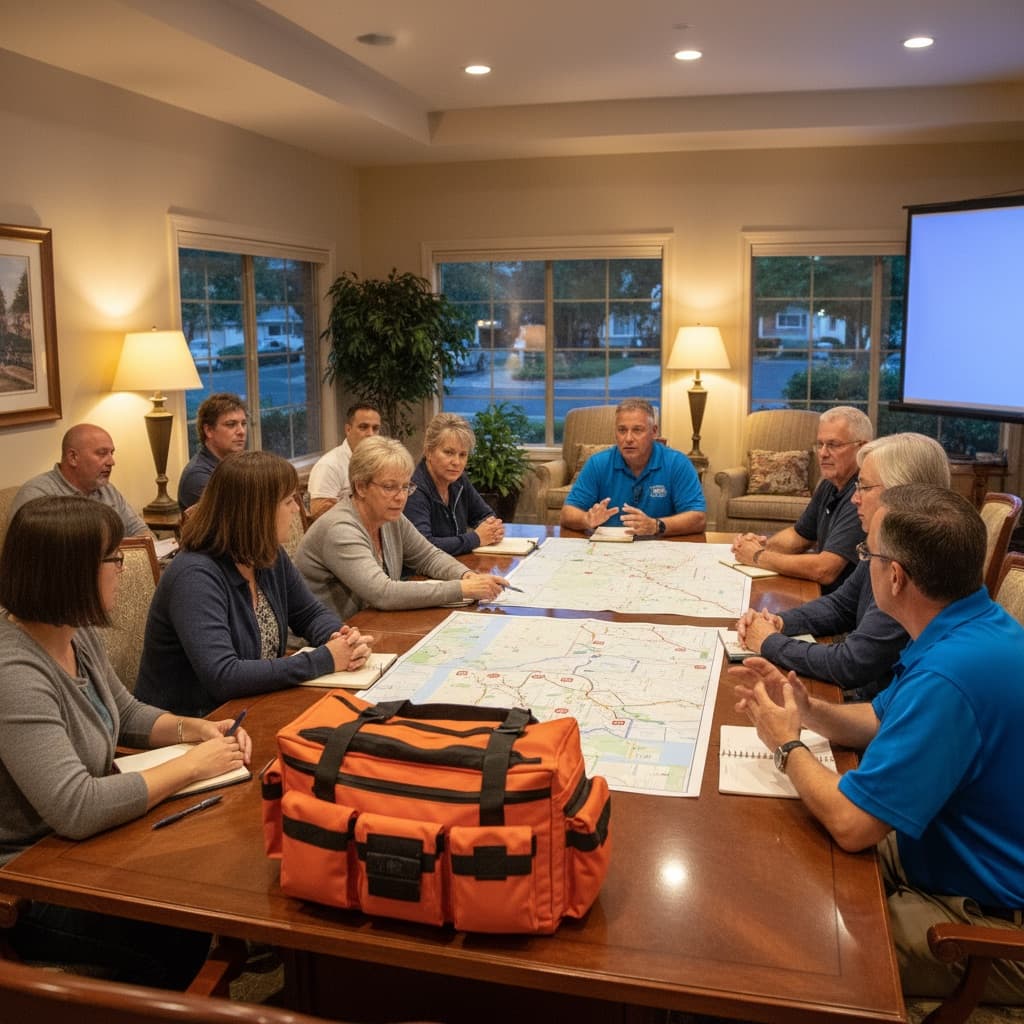
Hurricane Helene hit western North Carolina in September 2024. Dozens of HOA communities in the Asheville area were cut off from emergency services for days. Roads washed out. Power was gone for weeks. Cell towers failed. Boards that had emergency plans activated them and accounted for every resident within hours. Boards that didn't were still trying to reach homeowners five days later.
I've talked to board members from three of those communities. The ones who had plans said the same thing: the plan wasn't perfect, but having one meant they weren't starting from zero when everything went wrong. The ones without plans said they'd never make that mistake again.
Most HOA boards don't think about emergencies until one happens. That's human nature. But you're a fiduciary. You have a legal duty to protect the association's assets and the safety of common areas. A $2,000 investment in emergency planning can prevent hundreds of thousands in uninsured losses and — more importantly — keep people safe.
Why HOAs Need Their Own Emergency Plans
Your city or county has an emergency management plan. Your state has one too. So why does your HOA need its own?
Because municipal plans don't cover your pool house, your clubhouse, your stormwater retention ponds, or the 200 families living in your community. Fire departments prioritize structure fires and life safety. Public works clears major roads first. Your private streets, shared parking lots, and common area trees? Those are your problem.
A 120-unit community in Houston learned this during Hurricane Harvey. Floodwater sat in their clubhouse for six days before any public resources arrived. By that time, $180,000 in mold damage had set in. The board's insurance covered structure replacement, but the mold remediation claim was denied because they hadn't taken "reasonable steps" to mitigate damage — like running pumps or tarping openings. The insurer argued that a reasonable HOA would have had emergency supplies and a plan to deploy them.
That argument held up. The association ate the loss.
Building Your Emergency Plan: The Core Components
An HOA emergency plan doesn't need to be 50 pages. In fact, the longer it is, the less likely anyone will read it. Aim for 8-12 pages covering five areas. Print copies for every board member and keep a waterproof version in your clubhouse or management office.
1. Roles and Responsibilities
Assign specific roles before disaster strikes. During an emergency, "someone should handle this" means nobody handles it.
- Emergency coordinator: One board member owns the plan. They activate it, assign tasks, and serve as the primary point of contact with emergency services. This is usually the board president, but it doesn't have to be — pick whoever is most reliable and level-headed under pressure.
- Communications lead: Responsible for activating the communication tree, posting updates, and coordinating with local media if needed. This person should have access to all community communication tools — your HOA management platform, email lists, and any group text chains.
- Property assessment lead: Walks the community after the event to document damage with photos and video. This person ideally has construction or facilities experience.
- Resident welfare coordinator: Checks on vulnerable residents — elderly homeowners, people with disabilities, families with infants. Maintains an opt-in list of residents who may need assistance during emergencies.
- Insurance and finance lead: Usually the treasurer. Files insurance claims, tracks expenses, and coordinates with FEMA if applicable.
Each role should have a primary and a backup. People travel. People get injured. If your emergency coordinator is the only person who knows where the shutoff valves are, you have a single point of failure.
2. Communication Tree
This is the single most important part of your plan. When a tornado warning drops at 2 AM or a wildfire is approaching, you need to reach every household fast. Here's what works:
Layer 1 — Mass text/SMS: The fastest way to reach people. Most HOA management platforms support email notifications, and many boards supplement with a group text service like Community or a simple group text chain. SMS works even when internet is down, as long as cell towers are up.
Layer 2 — Email blast: Send a detailed email with specific instructions. Include what happened, what the board is doing, what homeowners should do, and when the next update will come. Email is better for detailed information but slower and requires internet access.
Layer 3 — Door-to-door: When power and cell service are down, someone has to physically knock on doors. Divide your community into zones of 10-15 homes each. Assign a zone captain (a volunteer homeowner, not necessarily a board member) who is responsible for checking on every home in their zone.
Test your communication tree twice a year. Send a non-emergency test message and track how many households confirm receipt within one hour. If you're below 80%, your contact information is stale and you need to update it.
3. Vulnerable Resident Registry
This is sensitive, so handle it carefully. Create an opt-in registry of residents who may need help during emergencies: seniors living alone, residents with mobility limitations, people dependent on electrically-powered medical equipment, families with newborns.
The registry should include their name, unit/address, emergency contact, and the nature of their needs. Store it securely — this is private health information. Only the emergency coordinator and resident welfare coordinator should have access. Update it annually.
A 75-unit community in Bend, Oregon told me their registry had 11 names on it. During a 4-day ice storm power outage in January 2024, volunteer zone captains checked on all 11 within the first 6 hours. Two needed transportation to a warming shelter. Without the list, those two residents could have been in serious danger.
4. Property Protection Procedures
Your plan needs specific instructions for protecting common area assets. These will vary by community, but typically include:
- Water shutoff: Know where every shutoff valve is located. Label them. If a pipe bursts in the clubhouse at midnight, whoever arrives first needs to find that valve in the dark.
- Pool and amenity securing: Remove loose furniture, cover equipment, lower pool water levels if flooding is expected, shut down pumps and electrical systems.
- Generator protocols: If you have a backup generator, document its location, fuel requirements, startup procedure, and what it powers. Post the procedure on the generator itself.
- Tree assessment: Identify high-risk trees (dead, leaning, or near structures) before storm season. Pre-negotiate with a tree service for emergency response.
- Document protection: Keep digital copies of all governing documents, insurance policies, vendor contracts, and financial records in cloud storage. If your clubhouse floods, you can't lose your only copy of the CC&Rs.
Emergency Supply Stockpile
You're not trying to outfit a bunker. You're trying to have basic supplies on hand so your board can respond in the first 24-48 hours before professional help arrives.
A reasonable stockpile for a 50-100 unit community costs $2,000-$4,000 to establish and $500-$1,000 per year to maintain. Store it in a secure, accessible location — your clubhouse, a dedicated storage shed, or a designated garage unit.
| Item | Quantity (50-100 units) | Approximate Cost |
|---|
| Heavy-duty tarps (20x30) | 10-15 | $400-$600 |
| Sandbags (filled or fill-your-own) | 100-200 | $200-$500 |
| Portable generator (5,000W+) | 1-2 | $600-$1,200 |
| Fuel (stabilized gasoline, 10 gal) | 2 containers | $80-$100 |
| Submersible pump | 1 | $150-$300 |
| First aid kits (industrial) | 2-3 | $100-$200 |
| Battery-powered radio | 2 | $40-$60 |
| Flashlights and batteries | 10-20 | $100-$200 |
| Bottled water (cases) | 10-20 | $60-$100 |
| Chainsaw + safety gear | 1 | $300-$500 |
Check expiration dates on water, batteries, and fuel every six months. Rotate fuel seasonally. If you've got a safety or emergency committee, assign them the inspection schedule.
Insurance: What's Covered and What Isn't
This is where boards get blindsided. Most HOA master insurance policies cover sudden, accidental damage to common area structures. But there are critical exclusions that catch unprepared boards off guard.
Common Exclusions
- Flood damage: Standard property insurance does not cover flooding. Period. If your community is anywhere near a floodplain, creek, or coastal area, you need a separate flood policy through the National Flood Insurance Program (NFIP) or a private flood insurer. NFIP policies for commercial buildings (which is how they classify HOA common areas) max out at $500,000 in building coverage.
- Earthquake damage: Not covered by standard policies. Communities in seismic zones need separate earthquake coverage.
- Gradual damage: Mold from a slow leak? Rot from deferred maintenance? Settling foundation? These aren't covered because they're not "sudden." This is why the Houston community's mold claim was denied — the insurer argued the mold was the result of failure to mitigate, not the hurricane itself.
- Deferred maintenance: If a roof fails during a storm because it was 5 years past its replacement date, the insurer can deny the claim. Keep your reserve study current and your maintenance schedule documented.
Filing Claims Correctly
After a disaster, you have 72 hours to notify your insurer. Some policies require 24 hours. Don't wait to assess the full scope — file a preliminary claim immediately and supplement it later.
- Document everything before cleanup: Take timestamped photos and video of all damage from multiple angles. Include wide shots that show context and close-ups that show detail. Walk through every common area and photograph it whether you see damage or not — you may discover hidden damage later, and "before" photos of undamaged areas help your claim.
- Separate emergency repairs from permanent repairs: Emergency repairs (tarping a roof, pumping water, boarding windows) are covered under "emergency protective measures" and don't need pre-approval. Permanent repairs usually need adjuster approval before work begins. Keep all receipts for emergency work.
- Get your own adjuster: Your insurer's adjuster works for the insurer. Consider hiring a public adjuster who works for you. They typically charge 5-10% of the claim amount, but communities that use public adjusters consistently receive 20-50% higher settlements. For a $100,000+ claim, that math works out fast.
- Track every expense: Keep a dedicated spreadsheet or use your financial management tools to log every emergency-related expense: labor, materials, equipment rental, temporary facilities, and even board member time. All of this is potentially reimbursable through insurance or FEMA.
FEMA and Federal Disaster Assistance
When the President declares a federal disaster, FEMA's Public Assistance (PA) program can reimburse eligible costs for HOAs. Most boards don't know this. Many assume FEMA only helps individuals and municipalities. That's not true.
HOAs qualify as "private nonprofit organizations" under FEMA's PA program if they provide essential services to the community. Common area maintenance, stormwater management, and private road maintenance all count. Here's what's eligible:
- Category A — Debris removal: Clearing fallen trees, damaged fencing, and debris from common areas and private roads.
- Category B — Emergency protective measures: Sandbagging, pumping, tarping, temporary fencing, generator fuel, and security during evacuations.
- Category E — Roads and bridges: Repair of private roads and bridges owned by the association.
- Category G — Parks, recreational, and other: Repair of pools, clubhouses, playgrounds, and other common area facilities.
The process works like this: after a presidential disaster declaration, register your HOA with FEMA within 30 days at DisasterAssistance.gov or by calling 800-621-3362. A FEMA representative will schedule a site inspection. Document your costs meticulously — FEMA reimburses 75% of eligible expenses, and some states cover the remaining 25% match.
A 300-unit community in Fort Myers, Florida received $420,000 in FEMA reimbursements after Hurricane Ian for debris removal, road repair, and emergency protective measures. Their board president told me the application took about 40 hours of documentation work. Without it, that $420,000 would have been a special assessment of $1,400 per home.
Disaster-Specific Planning
Your plan should include specific procedures for the disasters most likely in your area. Here are the big four:
Hurricanes and Tropical Storms
You typically get 48-72 hours of warning. Use it. Your plan should include a pre-storm checklist: secure outdoor furniture and signage, clear storm drains, inspect and test sump pumps, verify generator fuel, send resident notification with preparation instructions, and activate the communication tree. Post-storm: property assessment team walks the community within 4 hours of the all-clear, documents damage, and reports to the emergency coordinator.
Wildfires
Wildfire preparation is ongoing, not last-minute. Maintain defensible space around all common area structures (30 feet minimum of cleared vegetation in most fire codes). Clear dead brush, trim trees 10 feet from structures, clean gutters of dry leaves, and ensure emergency vehicle access to all common areas. During fire season, monitor air quality and provide guidance to residents with respiratory conditions.
Earthquakes
No warning. Your plan is entirely about response. Shut off gas mains immediately after shaking stops. Check for structural damage before allowing re-entry to any common area buildings. Inspect parking structures, retaining walls, and pool decks for cracks. Account for all residents through the communication tree within 2 hours.
Winter Storms and Ice
Common in the Pacific Northwest and across the northern states. Pre-position salt and sand for walkways and private roads. Know where your water shutoff valves are — frozen pipes that burst in a clubhouse can cause $50,000+ in damage. If you're in Washington or Oregon, your CC&Rs may specify who is responsible for snow removal on private roads versus individual driveways. Clarify this before the first snowfall.
Annual Preparedness Calendar
Don't wait for hurricane season to start thinking about this. Spread the work across the year.
| Month | Action Item |
|---|
| January | Review and update the emergency plan. Update vulnerable resident registry. |
| February | Inspect and restock emergency supplies. Check generator, test fuel. |
| March | Review insurance policies — check coverage limits, deductibles, and exclusions. Verify flood/earthquake coverage if applicable. |
| April | Conduct spring communication tree test. Update contact information. |
| May | Pre-hurricane/storm season: inspect roofs, clear storm drains, trim high-risk trees. |
| June | Wildfire season prep (if applicable): defensible space inspection, gutter cleaning, brush clearing. |
| September | Post-summer review. Second communication tree test. |
| October | Winter storm prep: verify salt/sand supply, inspect heating systems in common areas, review snow removal contracts. |
| November | Board training refresher on emergency procedures. New board member orientation on the plan. |
What to Communicate to Homeowners
Your emergency plan is a board document. But homeowners need to know three things:
- How they'll be contacted: Explain the three-layer communication system (text, email, door-to-door) and make sure you have current contact info for every household. Send an annual update request — people change phone numbers more often than you'd think.
- What the HOA is responsible for vs. what they are: This is critical and often misunderstood. The HOA handles common area damage. Individual unit/home damage is the homeowner's responsibility. Spell this out clearly so nobody assumes the association will fix their fence or replace their windows after a storm.
- How to opt into the vulnerable resident registry: Frame it positively. "If you or someone in your household might need assistance during an emergency, please let us know so we can check on you." Include a simple form — name, unit, nature of need, emergency contact.
Post this information on your community communication channels and include it in your annual meeting presentation. A brief 5-minute segment at the annual meeting is enough to cover the basics and ask for zone captain volunteers.
Budgeting for Emergency Preparedness
Emergency preparedness isn't free, but it's cheap relative to the cost of being unprepared. Here's what to budget:
- Initial setup (Year 1): $3,000-$5,000 for supplies, plan development, and communication system setup.
- Annual maintenance: $1,000-$2,000 for supply restocking, generator maintenance, and communication tree testing.
- Insurance review: $0-$500 if you hire an insurance broker to review your policies annually. Many brokers do this as part of the renewal process.
- Training: $0-$300 per year. FEMA offers free online courses at training.fema.gov. The Community Associations Institute offers emergency preparedness modules for boards.
Build these costs into your annual operating budget as a line item, not a discretionary expense. A board that skips emergency preparedness to save $2,000 is the same board that'll face a $200,000 special assessment when disaster hits.
Legal Obligations and Liability
Board members have a fiduciary duty to protect association assets. Courts have found that this duty includes reasonable disaster preparedness. "Reasonable" doesn't mean preparing for a meteor strike. It means having a plan for the disasters that are foreseeable in your area.
A Florida appeals court ruled in 2023 that an HOA board's failure to maintain adequate flood insurance for common areas — despite being in a FEMA-designated flood zone — constituted a breach of fiduciary duty. Board members were held personally liable for the uninsured portion of the damage. Their D&O insurance covered the legal defense, but the judgment itself exceeded the policy limits.
The lesson: document your preparedness efforts. Meeting minutes should reflect that the board discussed emergency planning, reviewed insurance coverage, and approved the emergency supply budget. If you're ever challenged, the minutes are your evidence that you met your duty of care.
After the Emergency: Recovery and Lessons Learned
Once the immediate crisis passes, resist the urge to "get back to normal" too fast. Schedule a recovery debrief within two weeks while memories are fresh.
- Document what worked and what didn't: Was the communication tree effective? Did zone captains respond? Were supplies adequate? Be honest about failures — they're the most valuable learning opportunities.
- File all insurance claims: Compile damage documentation, contractor estimates, and expense receipts. Submit claims to your insurer and, if applicable, register with FEMA.
- Communicate recovery timeline to homeowners: People need to know when common areas will be repaired, what temporary measures are in place, and whether a special assessment may be necessary to cover uninsured costs.
- Update the plan: Every disaster teaches you something. Update your emergency plan based on what you learned. Add new procedures, adjust supply quantities, and replace volunteers who didn't fulfill their roles.
- Address mental health: Disasters are stressful. Board members are volunteers dealing with their own property damage while managing the community response. Acknowledge the strain. If your community has the resources, consider hosting a community gathering — even a simple coffee hour — to help people process what happened.
Getting Started Today
You don't need a committee, a consultant, or a budget approval to start. Here's what one board member can do this week:
- Download FEMA's free "Emergency Plan Template" from ready.gov and adapt it for your community.
- Pull your insurance policy declaration pages and check for flood and earthquake exclusions.
- Walk the community and photograph every shutoff valve, electrical panel, and generator. Store the photos in your document management system.
- Send a message to all homeowners asking for updated phone numbers and email addresses.
- Add "emergency preparedness" to the next board meeting agenda.
That's an afternoon of work. It won't give you a complete plan, but it'll give you a foundation. From there, assign the roles, stock the supplies, set up the communication tree, and test it. The communities that recover fastest from disasters aren't the wealthiest or the largest. They're the ones that planned.
For more on board responsibilities and governance, read our board member duties guide or explore how Effortless HOA can centralize your community's communications and document storage so nothing gets lost when you need it most.