I've sat in more HOA board meetings than I can count where the treasurer delivers the bad news: the pool pump failed, the parking lot needs resurfacing, the clubhouse roof is leaking — and there's $11,000 in the reserve account against a $45,000 repair bill. The room goes quiet. Then someone asks the question nobody wants to answer: "How much is the special assessment going to be?"
That moment is entirely preventable. Reserve fund planning isn't glamorous. It's not the part of board service that anyone gets excited about. But it's the difference between a community that handles major repairs in stride and one that blindsides homeowners with $3,000 special assessments every few years.
This guide covers everything your board needs to know about reserve funds: how much to save, how reserve studies work, what "percent-funded" actually means, which states have legal requirements, and how to invest reserves responsibly.
What Is an HOA Reserve Fund?
A reserve fund is a dedicated savings account that an HOA maintains for the repair and replacement of major common area components. Think of it as the community's capital budget — the money set aside for big-ticket items that will eventually wear out and need to be fixed or replaced.
The key distinction is between operating expenses and capital expenses. Your operating fund pays for the things that happen every month: landscaping, utilities, insurance premiums, management software. Your reserve fund pays for the things that happen every 10, 15, or 25 years: a new roof, road repaving, pool resurfacing, elevator modernization.
These two funds should always be held in separate bank accounts. Always. Commingling them is one of the most common — and most dangerous — financial mistakes HOA boards make. When you mix the money, you can't tell whether you're actually saving for future repairs or just spending slower than you're collecting. I worked with a community in Clark County that had $180,000 in a single bank account and thought they were in great shape. When we separated operating and reserve funds, the real reserve balance was $47,000 — against $310,000 in projected needs over the next five years.
The Percent-Funded Method: How to Measure Reserve Health
Raw dollar amounts don't tell you whether your reserves are adequate. A community with $200,000 in reserves might be in excellent shape or critically underfunded — it depends entirely on what needs to be repaired, when, and at what cost.
The percent funded method solves this. It compares your current reserve balance to the "fully funded balance" — the amount you'd ideally have based on how much each component has aged.
Here's a concrete example. Say your community has an asphalt parking lot that costs $120,000 to resurface and has a 20-year useful life. If the lot is 10 years old (halfway through its life), the fully funded balance for that one component is $60,000. You should have half the replacement cost saved because half the useful life is used up. Now do that calculation for every reserve component in your community — roofs, fences, pool equipment, roads, paint, mechanical systems — and add them up. That total is your fully funded balance.
If the fully funded balance is $500,000 and you have $375,000 in reserves, you're 75 percent funded. The National Reserve Study Standards (used by the Association of Professional Reserve Analysts and Community Associations Institute) define four funding ranges:
- Strong: 70 to 100 percent — The community can handle expected repairs without special assessments. This is the target range.
- Fair: 30 to 70 percent — Some risk. Minor timing changes or cost overruns could trigger a special assessment.
- Weak: 10 to 30 percent — Significant risk. The community likely cannot handle a major component failure without a special assessment or loan.
- Critical: Below 10 percent — The community is functionally uninsured against capital expenses. Special assessments are nearly inevitable.
Most financial advisors and reserve professionals recommend maintaining reserves at 70 percent funded or higher. I'd push for 80 to 100 percent if your community can manage it. The margin gives you a cushion when costs come in higher than expected — and in my experience, they usually do. If you have your current balance and your latest reserve study handy, you can check yours with the percent funded calculator.
Reserve Studies: What They Are and What They Cost
A reserve study is a professional analysis that identifies every major common area component, estimates its remaining useful life, calculates the current replacement cost, and produces a funding plan. It's the foundation of responsible reserve planning.
What a Reserve Study Includes
A complete reserve study has two parts:
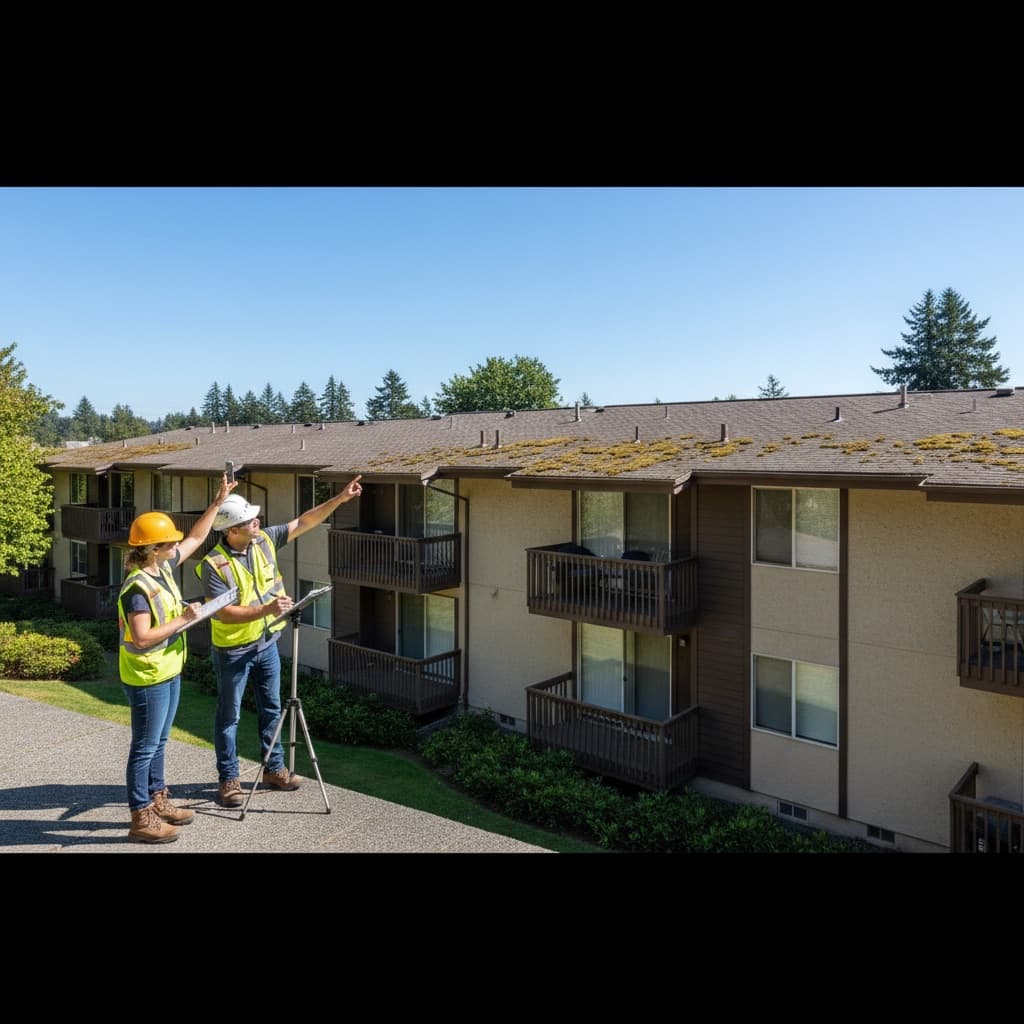
- Physical analysis: An on-site inspection of all reserve components. The analyst walks the property, examines roofing, paving, mechanical systems, pool equipment, fencing, paint, drainage — everything with a predictable useful life and a replacement cost that wouldn't be reasonable to include in the annual operating budget. Each component gets a condition rating, estimated remaining useful life, and replacement cost estimate.
- Financial analysis: Based on the physical findings, the analyst calculates the fully funded balance and recommends an annual contribution plan. The financial analysis typically models multiple funding scenarios: full funding (reaching 100 percent funded), threshold funding (staying above a minimum like 70 percent), and baseline funding (never going below zero). The full funding approach is the most conservative and recommended.
How Much Reserve Studies Cost
Reserve studies typically cost between $3,000 and $8,000, depending on community size and complexity. A 50-unit townhome community with a pool and clubhouse might pay $3,500. A 300-unit planned community with multiple building types, extensive common areas, roads, and recreational facilities could pay $7,000 to $8,000. Condo associations with shared building systems (roofs, elevators, fire suppression, HVAC) tend to be at the higher end.
That cost is trivial compared to the alternative. I've seen communities hit with $200,000 in unplanned repairs because nobody spent $4,000 on a study that would have flagged the problem years earlier. The study pays for itself many times over.
How Often to Update
The standard recommendation is a full reserve study update every three to five years. Between full updates, the board should review the funding plan annually and adjust contributions for completed projects, new components, or significant cost changes. California Civil Code 5550 mandates an update at least every three years. Even without a legal requirement, updating every three to five years keeps your projections realistic as material costs, labor rates, and component conditions change.
Finding a Qualified Analyst
Look for analysts credentialed by the Community Associations Institute (RS designation) or the Association of Professional Reserve Analysts (PRA designation). Both organizations require education, experience, and adherence to the National Reserve Study Standards. Avoid general contractors or property managers who "also do reserve studies" — this is a specialized discipline, and the quality difference shows.
Common Reserve Components and Costs
Every community is different, but here's a reference table of typical reserve components, useful life ranges, and replacement costs. Your actual numbers will vary based on location, material quality, and community size. For per-component detail beyond this table, browse our component useful life database.
| Component |
Useful Life (years) |
Typical Replacement Cost |
| Asphalt roads/parking lots |
20 to 25 |
$50,000 to $200,000 |
| Roofing (composition shingle) |
20 to 30 |
$15,000 to $40,000 |
| Roofing (tile or metal) |
30 to 50 |
$25,000 to $75,000 |
| Pool resurfacing and equipment |
10 to 15 |
$25,000 to $60,000 |
| Exterior paint (wood siding) |
5 to 8 |
$15,000 to $50,000 |
| Fencing (wood) |
15 to 20 |
$10,000 to $35,000 |
| Fencing (vinyl or metal) |
20 to 30 |
$12,000 to $45,000 |
| Playground equipment |
15 to 20 |
$20,000 to $60,000 |
| Concrete sidewalks and curbs |
25 to 40 |
$15,000 to $50,000 |
| Clubhouse HVAC system |
15 to 20 |
$8,000 to $25,000 |
| Elevator modernization |
20 to 25 |
$75,000 to $150,000 |
| Irrigation system |
15 to 25 |
$10,000 to $40,000 |
| Storm drainage |
30 to 50 |
$20,000 to $80,000 |
| Entry monument/signage |
15 to 25 |
$5,000 to $20,000 |
A mid-size community with 100 to 150 homes, a pool, a clubhouse, and private roads might have a total replacement value of $400,000 to $800,000 across all components. At 75 percent funded, that means maintaining $300,000 to $600,000 in reserves. That's a big number, which is exactly why you need a disciplined annual contribution plan — you can't save that amount in a year or two.
How Much Should Your HOA Contribute Annually?
The short answer: whatever your reserve study says. The study's funding plan will specify an annual contribution amount calibrated to your specific components, their age, and their replacement costs.
If you don't have a reserve study yet (get one), a common rule of thumb is that reserve contributions should represent 25 to 40 percent of total annual assessments. A community collecting $200,000 per year in dues would allocate $50,000 to $80,000 to reserves. But this is a rough guideline, not a substitute for a real analysis.
A more precise approach without a full study: list every major component, estimate its replacement cost, and divide by its useful life. A $120,000 parking lot with a 20-year life needs $6,000 per year. A $30,000 pool resurfacing on a 12-year cycle needs $2,500 per year. Add up all the annual amounts, and that's your minimum contribution. Then add 10 to 15 percent to account for inflation and cost uncertainty.
For a deeper dive on budgeting these contributions alongside operating expenses, see our HOA budget planning guide.
Special Assessments vs. Adequate Reserves
Special assessments are the price communities pay for inadequate reserve planning. They're one-time charges levied on every homeowner to cover a capital expense that reserves can't handle. And homeowners hate them — justifiably.
A $4,000 special assessment hits differently than $33 per month in dues. The monthly amount is budgeted, expected, invisible. The lump sum is a financial shock. Some homeowners can't pay it. Others are furious that the board "let this happen." Regardless of how the board explains it, a special assessment signals that somebody wasn't planning ahead.
The math tells the story clearly. Take a 120-home community that needs a $180,000 road resurfacing in 10 years:
- With reserves: Contribute $18,000 per year for 10 years. That's $150 per home per year, or $12.50 per month. Barely noticeable in the dues structure.
- Without reserves: Levy a $1,500 special assessment on each homeowner when the road fails. Or worse, defer the repair until it costs $240,000 because the base has deteriorated, bringing the assessment to $2,000 per home.
Special assessments also affect property values. Prospective buyers and their agents check for pending or recent special assessments. A community with a history of them — or one with visibly underfunded reserves — will sell at a discount compared to a well-funded neighbor. Lenders look at this too. Fannie Mae and FHA guidelines consider reserve funding levels when approving condo and PUD loans. A community below 10 percent funded can face loan restrictions that make it harder for homeowners to sell.
State Requirements for HOA Reserve Funds
Reserve fund requirements vary dramatically by state. Some have detailed mandates. Most leave it to the board's fiduciary judgment. Here are the key states with specific requirements:
California (Civil Code 5550)
California has the most prescriptive reserve requirements in the country. Associations with major common area components must conduct a reasonably competent and diligent visual inspection at least every three years. The reserve study must include identification of all major components, estimates of remaining useful life and replacement cost, an estimate of the total annual contribution needed, and the current reserve fund balance and percent-funded level. The board must also distribute an annual reserve funding disclosure to all members. Following the Surfside condo collapse in Florida, California strengthened its inspection requirements for older buildings with Senate Bill 326.
Washington (RCW 64.38)
Washington's Homeowners' Association Act requires the board to adopt a budget that includes reserve contributions. While the statute doesn't mandate a specific reserve study format, it requires the board to exercise reasonable care in planning for common area maintenance and replacement. The state's WUCIOA (RCW 64.90) for newer communities has more detailed reserve provisions, including a requirement to disclose the reserve study's recommended funding level to purchasers.
Florida (720.303)
Florida requires HOAs to include reserve accounts in their annual budgets for roof replacement, road resurfacing, and any other item with a deferred maintenance expense exceeding $10,000. However — and this is a big however — reserves can be waived or reduced by a majority vote of the homeowners at the annual meeting. Many Florida communities routinely waive reserves to keep dues low, which is how you end up with aging communities that can't afford critical repairs. The state has been tightening these rules, especially for condominiums, after the Champlain Towers collapse.
Virginia, Nevada, and Others
Virginia requires an annual reserve disclosure. Nevada (NRS 116) requires a reserve study and annual update. Colorado, Hawaii, and several other states have varying reserve provisions. Even in states without specific requirements, courts have consistently held that the board's fiduciary duty includes planning for foreseeable capital expenses. A board that collects dues for 15 years without saving for the roof replacement it knew was coming has arguably breached that duty.
Investing HOA Reserves Responsibly
Reserve funds sitting in a basic savings account earning 0.5 percent are losing purchasing power to inflation every year. A community with $400,000 in reserves loses $8,000 to $12,000 in purchasing power annually at 2 to 3 percent inflation. Responsible investing can offset some of that erosion.
But — and this is critical — HOA reserves are not an investment portfolio. They're funds that the community will need at specific, somewhat predictable times. The investment strategy must prioritize safety and liquidity above returns. Nobody wants to hear that the pool can't be resurfaced because the reserve fund is locked in a 5-year investment that hasn't matured yet.
Appropriate Investment Vehicles
- Laddered CDs: Purchase certificates of deposit with staggered maturity dates (6 months, 12 months, 18 months, 24 months). As each CD matures, reinvest it at the longest term or use the funds if needed. Laddering provides regular access to portions of the fund while earning higher rates than savings accounts. As of early 2026, 12-month CDs are yielding 4.0 to 4.5 percent.
- Treasury securities: U.S. Treasury bills and notes are the safest investment available. They're backed by the full faith and credit of the federal government and come in maturities from 4 weeks to 10 years. A laddered Treasury portfolio can yield 4 to 5 percent with zero credit risk.
- Money market accounts: Higher yields than regular savings (currently 3.5 to 4.5 percent at many institutions) with full liquidity. A good option for the portion of reserves that may be needed in the next 12 months.
- FDIC-insured savings: The most liquid and safest option, but lowest yield. Keep enough in regular savings to cover any expected expenditures within the next six months.
What to Avoid
Do not invest HOA reserves in stocks, mutual funds, real estate, or any other asset class with material risk of principal loss. This isn't the board's personal money — it belongs to the community, and you have a fiduciary obligation to protect it. I've seen exactly one HOA try to "grow" reserves in the stock market. They put $180,000 in an equity fund in 2021, watched it grow to $210,000, and then watched it drop to $155,000 during the 2022 correction — right when they needed $65,000 for a roof repair. Don't be that board.
Also check your governing documents and state law for any restrictions on reserve fund investments. Some CC&Rs limit investments to FDIC-insured accounts or government-backed securities.
Tracking Reserves with HOA Software
Spreadsheets work until they don't. A reserve tracking spreadsheet breaks when the treasurer changes, when someone accidentally overwrites a formula, or when the board needs a quick answer about reserve health during a meeting.
Modern HOA management software handles reserve tracking as part of its financial management suite. The specific capabilities that matter most for reserve management:
- Separate fund accounting: Operating and reserve funds tracked independently with their own general ledger accounts, so you always know the true reserve balance without manual reconciliation.
- Financial reports: Balance sheets, income statements, and reserve fund status reports generated on demand. Our financial reporting guide details the reports every board should review monthly.
- Budget vs. actual tracking: See how reserve contributions compare to the budget in real time, not at year-end when it's too late to adjust.
- GL accounting: Double-entry general ledger with a proper chart of accounts, so every reserve contribution and expenditure is recorded accurately. Journal entries create an auditable paper trail.
- Board dashboards: A financial overview that shows reserve balances alongside operating cash, dues collection rates, and aging receivables. The board gets a complete financial picture without waiting for the treasurer to compile a report.
For long-term capital planning specifically, we built Reserve Planner — a standalone tool ($49/yr or $6/mo per association) that tracks component useful life, funding scenarios, and percent funded over time. And if you just want a quick read on whether your current contributions are on track, our free reserve fund calculator requires no signup.
If your community is still tracking finances in spreadsheets, take a look at Effortless HOA's pricing — the cost of the software is a rounding error compared to the financial exposure of poor reserve tracking. And for self-managed communities without a management company handling finances, software isn't optional — it's how you keep your volunteer treasurer sane.
Building a Reserve Fund from Behind
Not every community starts from a strong position. If your reserves are underfunded — say, below 40 percent — you need a catch-up plan. Jumping straight to full funding in one year means a massive dues increase that homeowners won't accept. The realistic approach is a phased plan over five to seven years.
Step 1: Get a Reserve Study
You can't fix what you haven't measured. Commission a reserve study so you know exactly where you stand and what the gap is. The study will model different funding scenarios and show the board what each one requires in terms of annual contributions.
Step 2: Set a Target Funding Level
Your goal should be 70 percent funded within five to seven years. The reserve study's full funding plan will show the annual contribution needed to reach this target. It's usually a combination of increased contributions and, in the first year or two, a larger catch-up contribution.
Step 3: Increase Dues Gradually
A 15 to 20 percent dues increase in one year is hard to swallow. But a 5 to 7 percent increase per year for five years is manageable and gets you to the same place. Present the multi-year plan to homeowners so they see the trajectory and understand why the increases are necessary. Be direct: "We can increase dues by $25 per month now, or we can wait until the parking lot fails and levy a $3,500 special assessment."
Step 4: Review Annually
Each year, compare the actual reserve balance to the plan. Adjust contributions if costs have changed, projects have been completed ahead of schedule, or new components have been added. A catch-up plan only works if the board revisits it every budget cycle.
Common Reserve Fund Mistakes
After working with hundreds of communities, I see the same mistakes come up again and again:
- Skipping the reserve study: "We know what needs to be fixed" is not a reserve plan. Every community thinks they know until the study reveals three components they'd overlooked. The $4,000 to $6,000 cost of a study is nothing compared to a $100,000 surprise.
- Underfunding reserves to keep dues low: This is the single most destructive financial decision a board can make. Low dues today mean special assessments tomorrow. It's not savings — it's deferral.
- Commingling operating and reserve funds: Two separate bank accounts. No exceptions. You need to know the real number, and you can't know it when the money is mixed.
- Raiding reserves for operating shortfalls: If the operating budget comes up short, cut expenses or increase dues. Don't "borrow" from reserves. The money is almost never repaid, and it puts the community at risk for capital expenses.
- Ignoring inflation in replacement costs: A roof that costs $30,000 today will cost $38,000 in five years at 5 percent construction inflation. Your reserve study should use inflation-adjusted replacement costs, not today's prices.
- Investing too aggressively: Reserve funds aren't venture capital. Stick to FDIC-insured deposits, CDs, and government-backed securities. The extra 2 percent yield from riskier investments isn't worth the chance of a principal loss.
Reserve Disclosures and Resale Impact
Reserve fund status directly affects property values. Most states require some form of financial disclosure when a home in an HOA is sold. Buyers and their agents review the HOA's financial statements, reserve study, and funded percentage as part of due diligence.
A well-funded reserve (70 percent or above) is a selling point. It signals a well-managed community with no pending special assessments. A poorly funded reserve (below 30 percent) is a red flag that can slow sales, reduce offers, or cause deals to fall through entirely.
Lenders care too. Fannie Mae's guidelines for condo and PUD loans include questions about reserve adequacy. Communities with very low reserves or recent special assessments may not qualify for conventional financing, forcing buyers into less favorable loan products. This creates a vicious cycle: underfunded reserves lead to lower property values, which lead to lower assessments, which lead to even more underfunded reserves.
For a broader look at managing all aspects of HOA finances, including the reports and dashboards that make reserve tracking practical, see our financial reporting guide. And if your community is just getting started with organized financial management, our HOA glossary covers the key terms you'll encounter along the way.
The Bottom Line
Reserve planning isn't exciting. Nobody runs for the HOA board because they're passionate about asset depreciation schedules. But it's the single most important financial responsibility the board has. A community with healthy reserves handles major repairs without drama. A community without them lurches from crisis to crisis, levying special assessments that frustrate homeowners and erode property values.
Get a reserve study. Fund to 70 percent or higher. Keep reserves in separate accounts. Invest conservatively. Review the plan every year. These five things will do more for your community's long-term financial health than any other action your board can take.