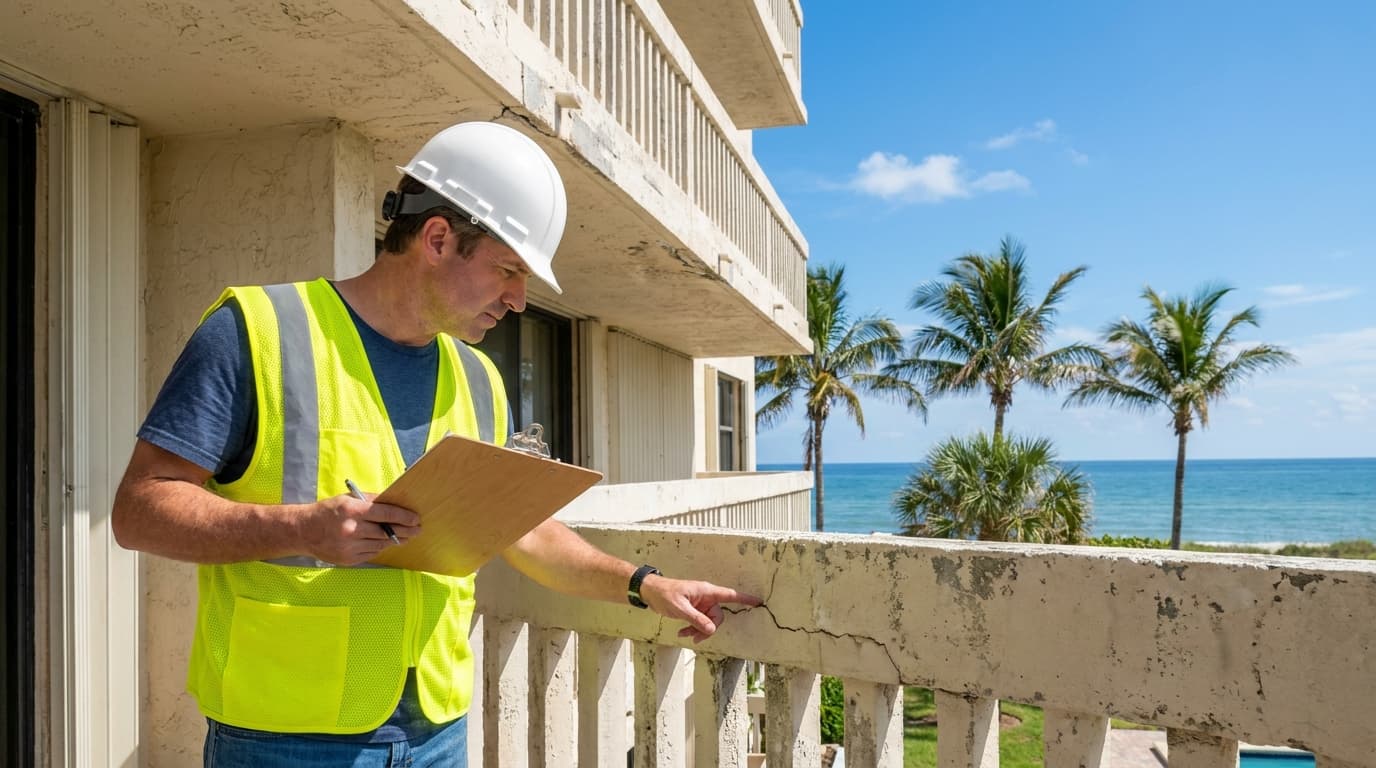
Quick answer: a milestone inspection is a structural safety inspection required by Florida Statute 553.899 for condominium and cooperative buildings three stories or taller. The first inspection is due by December 31 of the year the building turns 30 — measured from its certificate of occupancy — and local building officials can require it at 25 years for buildings in harsher environments, such as those near salt water. After the first one, it repeats every 10 years. Phase 1 is a visual examination by a Florida-licensed architect or engineer; phase 2, which involves actual testing, happens only if phase 1 finds substantial structural deterioration. The local building department administers the program, the association pays, every owner must receive a summary, and phase 2 repairs are mandatory. One caution up front: this statute has been amended repeatedly since 2022, so verify the current text of Fla. Stat. 553.899 and confirm deadlines with your local building department before relying on any summary, including this one.
Where Milestone Inspections Came From
On June 24, 2021, the Champlain Towers South condominium collapsed in Surfside, Florida, killing 98 people. The building was roughly 40 years old, an engineer had documented serious structural deterioration three years earlier, and the association was still working out how to pay for repairs when the building came down. Florida had no statewide requirement that aging condo buildings ever be structurally inspected — Miami-Dade and Broward had local recertification programs; the rest of the state had nothing. The milestone inspection statute is the direct legislative answer to that gap.
The law arrived in installments: SB 4-D (May 2022) created the requirement, SB 154 (2023) reworked the deadlines and the coastal rule, and later sessions adjusted enforcement and disclosure details. The practical consequence: most online summaries describe a superseded version of the statute. Our Florida HOA and condo law guide covers the broader landscape; for milestone specifics, the current statutory text and your local building department are the only authorities that matter.
Which Buildings Are Covered
The test is height, not unit count and not age of the association. Condominium and cooperative buildings that are three stories or taller — with height determined by the local building official under the Florida Building Code — must have milestone inspections. A 12-unit, three-story walk-up is covered. A 300-unit community made up entirely of two-story buildings is not.
The statute carves out single-family, two-family, and three-family dwellings with three or fewer habitable stories above ground. Note that the milestone law is a building-safety statute, not a condo-governance statute: it lives in Chapter 553 (Florida's building code chapter) rather than Chapter 718, and it is enforced by the local enforcement agency — your city or county building department — not by the state's condo regulator.
The Deadline Clock
Deadlines run from the building's certificate of occupancy, and they attach to each building, not to the association. An association with four towers built in different years has four separate milestone clocks.
| Situation | When the inspection is due |
|---|
| Building reaching 30 years of age | By December 31 of the year it turns 30 |
| Building in a harsher environment (e.g., near salt water) | The local enforcement agency may require it at 25 years |
| Older buildings already past 30 when the law took effect | Catch-up deadlines have already passed — buildings with certificates of occupancy on or before July 1, 1992 were due by the end of 2024 (verify your building's exact deadline with your local enforcement agency — several jurisdictions extended initial compliance dates). If this is you, the building is overdue now |
| After the first inspection | Every 10 years |
Two details boards routinely miss. First, the 25-year coastal trigger is no longer an automatic three-mile rule — the original 2022 law drew a line at three miles from the coastline, but SB 154 replaced it with local discretion based on environmental conditions such as proximity to salt water. Whether your building is on the 25-year or 30-year clock is a question only your local building department can answer, so ask them in writing.
Second, there is a notice mechanism with its own clock. The local enforcement agency is responsible for determining which buildings in its jurisdiction must comply and for sending the association written notice. Once that notice arrives, the association must complete phase 1 within 180 days. Do not treat the notice as the starting gun, though — the statutory deadline applies whether or not the letter ever shows up, and engineers book out well ahead of December deadlines. Verify the current notice and timing rules in the statute; these procedural details are among the provisions that have been amended.
Milestone Inspection vs. SIRS: Two Different Laws
Florida's post-Surfside package created two separate obligations that get conflated constantly. The milestone inspection (Fla. Stat. 553.899) answers an engineering question: is this building structurally safe right now? The structural integrity reserve study, or SIRS (Fla. Stat. 718.112), answers a financial question: is the association saving enough money to replace its structural components before they fail? Different statutes, different professionals, different deliverables, different enforcement.
Many associations hire one engineering firm to do both in a single site visit, and the law has expressly accommodated pairing them. But completing one does not satisfy the other. This article covers only the milestone inspection; for the reserve-study side, see our guide to SIRS requirements for small condos and the condensed Florida reserve study requirements page.
Phase 1: The Visual Inspection
Phase 1 must be performed by an architect or engineer licensed in Florida. It is a visual examination of the building's habitable and non-habitable areas — the load-bearing walls and primary structural members, the roof structure, balconies, foundations, and the other systems that hold the building up — for the purpose of assessing the building's general structural condition. The inspector is looking for signs of substantial structural deterioration: significant cracking or spalling in structural concrete, corroded reinforcement, failing balcony connections, water intrusion that has reached structural elements.
Two things phase 1 is not. It is not destructive testing — nobody is coring concrete samples in phase 1. And it is not a cosmetic audit: the statute is explicit that surface imperfections such as minor cracks, peeling paint, or staining do not by themselves constitute substantial structural deterioration unless the licensed professional judges them to be a sign of it. A building can look tired and pass, and a building can look freshly painted and fail.
If the inspector finds no substantial structural deterioration, phase 1 is the end of it. The inspector seals a report, submits it to the association and the local enforcement agency, and the building's clock resets for 10 years. In practice, most buildings that have been reasonably maintained complete the process at phase 1.
Phase 2: When Deterioration Is Found
If phase 1 identifies substantial structural deterioration, the statute requires a phase 2 inspection. This is where the engineering gets serious: the inspector may perform destructive or nondestructive testing — at their discretion and to the extent they judge necessary — to determine how far the deterioration goes and what it will take to fix. The scope is inherently unpredictable, which is why nobody can honestly quote a phase 2 price before phase 1 is done.
The phase 2 report must describe the deterioration and recommend repairs, and it goes to both the association and the building department. Then comes the provision with real teeth: the association must commence repairs for the substantial structural deterioration within 365 days of receiving the phase 2 report. This is not a recommendation the board can table, study, or put to an owner vote the way a clubhouse renovation might be. Structural repairs identified in a milestone inspection are a statutory obligation, and a board that sits on them is exposing the building to enforcement action and its directors to personal fiduciary risk.
Paying for phase 2 repairs is the hard part, because milestone repairs are exactly the kind of large, sudden expense reserves rarely cover in full. Most associations fund them through some combination of reserves, a bank loan, and a special assessment — our special assessment guide walks through the approval mechanics and the owner-communication work that makes the difference between a difficult meeting and a revolt. Full disclosure: we make Effortless HOA, and its GL accounting and online collections exist for exactly this situation — tracking a multi-year repair assessment cleanly, invoice by invoice — but no software changes the underlying duty. The money has to be collected and the repairs have to happen either way.
The Board's Job, Start to Finish
The building department administers the program, but nearly all of the work lands on the association. Here is the sequence as it actually unfolds for a board:
| Step | What the board does |
|---|
| 1. Know your date | Pull the certificate of occupancy for each covered building and confirm with the building department whether you are on the 25- or 30-year clock |
| 2. Hire the inspector | Engage a Florida-licensed architect or engineer — ideally 6–12 months before the deadline, and get competing proposals |
| 3. Prepare access | Gather original plans if you have them, arrange access to roofs, mechanical rooms, and a sample of units and balconies |
| 4. Receive and file the report | The inspector submits the sealed report to the association and the local enforcement agency |
| 5. Distribute the summary | Provide the inspector-prepared summary to every unit owner and post it — the statute sets a short window (45 days under the current text; verify) and requires conspicuous posting, including on the association's website if it must maintain one |
| 6. Repair | If phase 2 found deterioration, commence repairs within 365 days of the report |
| 7. Keep the records | Milestone reports are official association records — owners can inspect them, and prospective purchasers are entitled to them in the sales process |
Step 5 deserves emphasis because it is the one boards skip out of discomfort. A report that flags problems is not something the board gets to sit on while it works out messaging — the distribution requirement exists precisely because Surfside's owners learned how bad their building's condition was far too late. Send the summary, post it, and pair it with a plain-English cover note about what happens next.
What a Milestone Inspection Costs
We are not going to invent a dollar figure, because the honest answer is that pricing varies too much to quote responsibly. What you can control is understanding the drivers, which is what lets you compare proposals intelligently:
- Building size and count. Fees scale with square footage, number of stories, and number of separate buildings — each building is its own inspection.
- Access. Balcony-heavy buildings, buildings requiring lifts or swing stages to examine the exterior, and buildings with no original structural drawings all cost more to inspect.
- Phase 2 scope. Phase 1 pricing is quotable in advance; phase 2 is priced only after phase 1 defines the problem. Treat any bundled "phase 1 + phase 2" flat quote skeptically.
- Deadline crowding. Engineering capacity in Florida tightens as statutory deadlines approach. Booking early is the single cheapest thing a board can do.
- Bundling with a SIRS. If your building also owes a structural integrity reserve study, one firm doing both on one site visit generally beats two separate engagements.
If You Blow the Deadline
The consequences arrive from several directions at once. The local enforcement agency can pursue code enforcement against a non-compliant association, and if deterioration goes unaddressed it can escalate to declaring the building unsafe — the doomsday scenario, because an unsafe-occupancy determination can empty a building. Separately, Florida law treats a willful failure by officers and directors to have a required milestone inspection performed as a breach of their fiduciary duty, which is personal exposure, not just association exposure.
The market consequences may bite sooner than the legal ones. Property insurers writing Florida condo coverage increasingly ask about inspection status at renewal, and an overdue milestone inspection is a hard question to answer on an application. Lenders reviewing condo purchases now routinely ask, through project questionnaires, about structural inspections and unfunded repairs — unanswered or badly answered questionnaires can make units in your building difficult to finance, which suppresses every owner's resale value. And because the inspection reports are disclosure items in resales, a missing report is visible to every buyer's attorney. Non-compliance is not a secret you get to keep.
Bottom Line
If you sit on the board of a Florida condo or co-op building three stories or taller, find your certificate of occupancy date this week and ask your building department, in writing, when your milestone inspection is due. If the answer is within two years, start collecting engineering proposals now. Phase 1 is a visual inspection most well-maintained buildings pass; phase 2 and its 365-day repair clock are serious but survivable with honest owner communication and a real funding plan. What is not survivable is pretending the deadline does not apply to you — the statute was written in the shadow of 98 deaths, and building officials have little patience for boards that treat it as optional. Verify everything against the current text of Fla. Stat. 553.899, and when the questions get consequential, spend the money on a Florida community-association attorney.