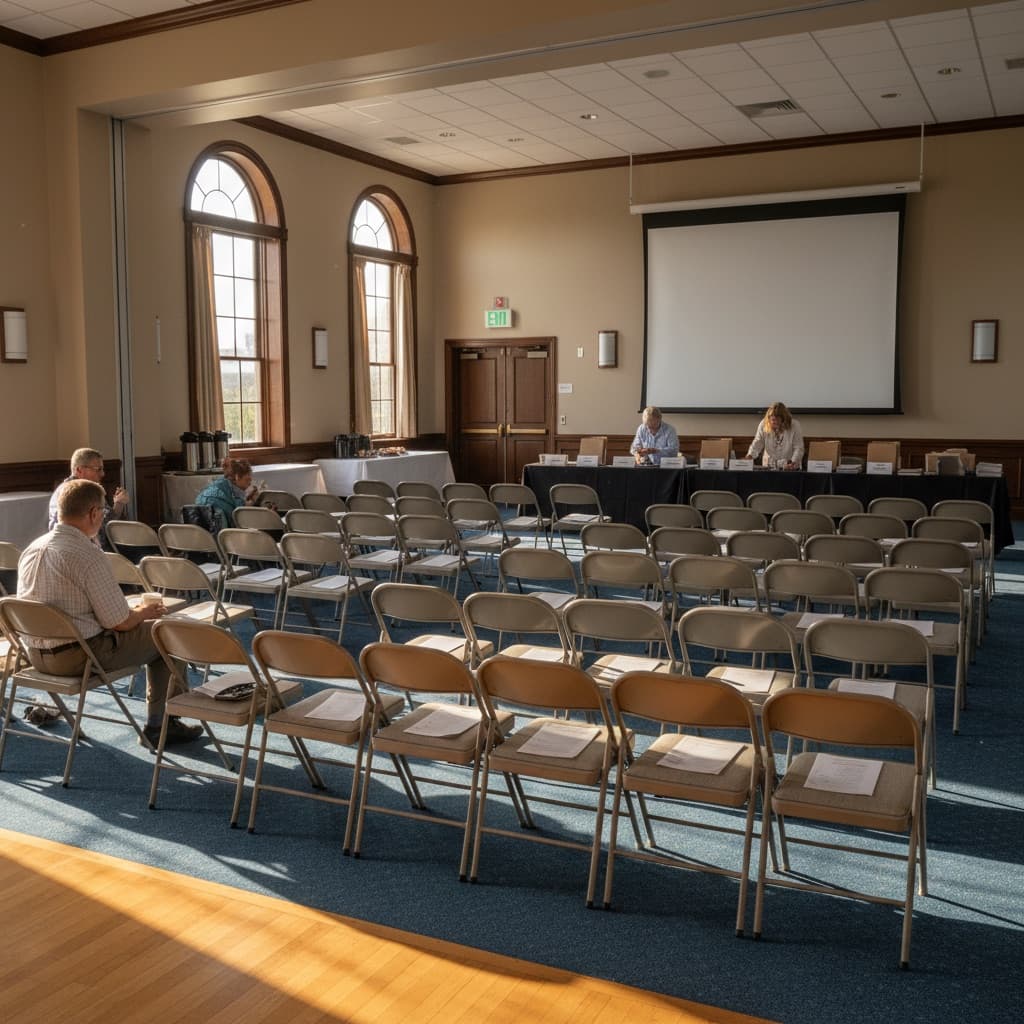
The annual meeting is the centerpiece of your HOA's governance calendar. It is the one occasion each year when the board formally reports to the full community, presents the financial position, adopts the budget, conducts elections, and addresses homeowner concerns. A well-run annual meeting reinforces confidence in the board's leadership. A disorganized one does the opposite.
This guide provides a comprehensive, step-by-step checklist for planning, conducting, and following up on your annual meeting. Whether this is your first annual meeting or your tenth, a structured approach ensures nothing falls through the cracks.
Review Your Governing Documents (60 to 90 Days Before)
Every annual meeting starts with your governing documents. Your CC&Rs and bylaws define the rules your meeting must follow. Before planning anything else, review these documents for the following requirements.
Quorum requirements: Your bylaws specify the minimum number of homeowners (by count or percentage) who must be present or represented by proxy to conduct business. Common quorum thresholds are 20 to 33 percent of total membership. If you cannot achieve quorum, the meeting cannot conduct official business, and you may need to adjourn and reconvene at a later date — some bylaws reduce the quorum requirement for a reconvened meeting.
Notice requirements: State law and your bylaws specify how far in advance meeting notices must be sent and by what method. In California, the Davis-Stirling Act (Civil Code Section 4920) requires at least 10 to 90 days' notice depending on the type of meeting. In Washington, RCW 64.38.035 requires notice of annual meetings be given to members. In Texas, Property Code Section 209.0051 requires written notice 10 to 60 days in advance. Know your specific requirements.
Election procedures: If board positions are up for election, your bylaws define the nomination process, voting method (in person, by ballot, by proxy), and any special requirements. California has detailed election rules under Civil Code Sections 5100 through 5145 that include secret ballot requirements and independent election inspectors.
Required agenda items: Some bylaws specify items that must be addressed at the annual meeting — budget ratification, reserve fund report, or ratification of the board's actions over the past year.
Set the Date, Time, and Location (45 to 60 Days Before)
Choosing the right logistics maximizes attendance and demonstrates respect for homeowners' time.
Date and time: Most communities find that weekday evenings (typically 6:30 or 7:00 PM) or Saturday mornings (9:00 or 10:00 AM) generate the best attendance. Avoid holidays, school events, and major sporting events if possible. Check your community's demographics — a retirement community may prefer a weekday morning, while a community with working families needs an evening or weekend slot.
Location: Book a space that can comfortably accommodate your expected attendance. Common options include community clubhouses, local church fellowship halls, school cafeterias or multipurpose rooms, hotel conference rooms, and public library meeting rooms. Ensure the space has adequate parking, ADA accessibility, and any audiovisual equipment you will need (microphone, projector, screen).
Virtual option: Consider offering a virtual attendance option through Zoom, Google Meet, or a similar platform. This increases participation from homeowners who cannot attend in person due to travel, health, or schedule conflicts. Check your bylaws to confirm that virtual attendance and voting are permitted. If your bylaws are silent on virtual attendance, consult your HOA attorney about whether your state law allows it.
Prepare and Send Meeting Notices (30 to 45 Days Before)
Meeting notices are a legal requirement, and failure to provide proper notice can invalidate any business conducted at the meeting.
Content of the notice: Your notice should include the date, time, and location of the meeting, the agenda or a summary of matters to be discussed, proxy forms with instructions for their completion and return, information about any items requiring a homeowner vote (budget ratification, CC&R amendments, special assessments), candidate nomination information if elections are on the agenda, and instructions for virtual attendance if offered.
Delivery method: Send notices via the method specified in your governing documents. Many bylaws require mailed notices; some permit email notification. Best practice is to use both: mail a formal notice and send an email reminder. Some communities also post notices on the community message board through their management platform.
Follow-up reminder: Send a reminder notice 7 to 10 days before the meeting. Include a link to submit proxies online (if your platform supports it) and a reminder of the agenda highlights. This second touch significantly improves attendance.
Prepare the Meeting Agenda and Materials (14 to 21 Days Before)
A well-prepared agenda keeps the meeting focused and ensures all required business is addressed.
Standard annual meeting agenda:
- Call to order: The president calls the meeting to order at the scheduled time.
- Determination of quorum: The secretary reports on quorum status. If quorum is not met, the meeting must either wait, adjourn, or proceed as an informational session only (no votes).
- Proof of notice: The secretary confirms that proper notice was given per governing documents.
- Approval of prior meeting minutes: Distribute last year's annual meeting minutes (ideally in advance) and approve them by vote.
- President's report: A summary of the year's accomplishments, challenges, and community updates.
- Treasurer's financial report: Year-to-date financial summary, reserve fund status, and the proposed budget for the coming year.
- Budget ratification: Present the proposed budget and open it for questions. Vote to ratify.
- Committee reports: Brief updates from any standing committees (architectural review, landscaping, social).
- Election of directors: If board positions are expiring, conduct nominations and elections per your bylaws.
- Old business: Follow up on items from previous meetings or the prior year.
- New business: Introduce any new matters for the coming year.
- Homeowner open forum: Allow homeowners to raise questions, concerns, and suggestions. Set a time limit (typically 15 to 30 minutes) and a per-person speaking limit (2 to 3 minutes) to keep the session manageable.
- Adjournment: Formally adjourn the meeting.
Supporting materials to prepare:
- Financial summary (income and expense, balance sheet, reserve status)
- Proposed budget for the coming year with line-item detail
- Board candidate statements (if elections are being held)
- Proxy forms (extras for homeowners who forgot theirs)
- Sign-in sheet to verify attendance and quorum
- Copies of the previous year's annual meeting minutes
- Any special reports or proposals referenced on the agenda
Verify Quorum and Conduct Elections (Day of Meeting)
Quorum verification: Before calling the meeting to order, tabulate all homeowners present in person, those attending virtually (if permitted), and those represented by valid proxy. Compare the total to your quorum requirement. If quorum is not met, you have three options: wait 15 to 30 minutes for additional homeowners to arrive, adjourn to a specific date (some bylaws allow a lower quorum for reconvened meetings), or proceed as an informational session without conducting any official business or votes.
Election procedures: If elections are on the agenda, follow your bylaws' prescribed process exactly. Typical steps include accepting nominations from the floor (if your bylaws allow floor nominations in addition to advance nominations), presenting candidate statements or allowing brief candidate speeches, distributing ballots (California requires secret ballots under Civil Code Section 5100), appointing election inspectors to count ballots if required, and announcing results before the meeting concludes.
Document the election results in detail: number of ballots cast, votes for each candidate, and the names of elected directors. If using proxies for voting, ensure proxy votes are separately counted and recorded.
Document and Distribute Meeting Minutes (Within 30 Days)
Meeting minutes are the official record of the annual meeting and have legal significance. They should be accurate, complete, and distributed promptly.
What to include in minutes:
- Date, time, and location of the meeting
- Confirmation that quorum was established (include the count)
- Confirmation that proper notice was given
- Names of board members present
- All motions made, including who made and seconded each motion
- The outcome of each vote (passed or failed, with the vote count)
- Election results with full candidate vote counts
- Key discussion points, especially homeowner questions and board responses
- Time of adjournment
What to avoid in minutes: Do not include a word-for-word transcript, personal opinions or editorializing, names of homeowners who raised specific complaints (unless relevant to a formal motion), or confidential information discussed in executive session.
Distribution: Distribute draft minutes to all homeowners within 30 days of the meeting (or within the timeframe specified by your governing documents). Many communities post minutes on their HOA management platform where all homeowners can access them. Minutes are formally approved at the next annual meeting (or the next board meeting, depending on your bylaws).
Post-Meeting Follow-Up (First 2 Weeks After)
The work does not end when the meeting adjourns. Prompt follow-up demonstrates that the board takes homeowner input seriously.
- Send a meeting summary: Within one week, send a brief email to all homeowners summarizing key outcomes — budget approval, election results, and any significant decisions or announcements. This reaches homeowners who did not attend.
- Address action items: Review the notes from the open forum and any commitments the board made during the meeting. Assign action items to specific board members with deadlines.
- Onboard new board members: If new directors were elected, schedule an orientation session to cover governing documents, financial status, ongoing projects, and their specific responsibilities.
- Update records: Update your management platform with new board member information, officer assignments, and any approved policy changes.
- File required documents: Some states require annual filings or reports. Ensure any filing requirements triggered by the annual meeting are completed on time.
Sample HOA Annual Meeting Agenda Template
Copy and customize this template for your community. Replace the bracketed items with your association's details.
[Community Name] Homeowners Association
Annual Meeting of Members — [Date]
[Location] — [Time]
- Call to Order — [President Name], President
- Determination of Quorum — [Secretary Name], Secretary (quorum = [X]% of [total] members = [number] members required)
- Proof of Notice — Confirmation that notice was mailed/emailed on [date], [X] days before the meeting
- Approval of [Prior Year] Annual Meeting Minutes — Motion to approve, second, vote
- President's Report — Year in review: accomplishments, challenges, and community updates (5-10 minutes)
- Treasurer's Financial Report — Year-to-date income/expenses, reserve fund balance, delinquency summary (10 minutes)
- Proposed [Year] Budget — Presentation, Q&A, motion to ratify (10-15 minutes)
- Committee Reports — Architectural review, landscaping, social (2-3 minutes each)
- Election of Directors — Positions up: [list positions]. Nominations, candidate statements, ballot distribution, vote count, results announcement
- Old Business — Follow-up on [list items from prior year]
- New Business — [List any new items for the coming year]
- Homeowner Open Forum — (15-30 minutes, 3-minute per-person limit)
- Adjournment
This template follows Robert's Rules of Order and covers the items most state statutes require. Adjust the time allocations based on your community's size and the complexity of the agenda items.
Tips for a Smooth Meeting
- Start on time: Begin at the scheduled time regardless of how many people are still arriving. This respects the time of homeowners who arrived punctually.
- Stick to the agenda: The annual meeting is not the forum for detailed debate on specific complaints. Acknowledge issues, note them for follow-up, and move on.
- Be prepared for difficult questions: Anticipate the questions homeowners are most likely to ask — about assessment increases, deferred projects, problem vendors, or enforcement actions — and prepare clear, honest answers.
- Use visuals: A simple slideshow showing financial charts, project photos, and the proposed budget is far more engaging than reading numbers aloud. Management platforms like Effortless HOA can generate financial reports that translate directly into presentation materials.
- End on a positive note: Conclude with accomplishments, upcoming community events, or improvements planned for the coming year. Leave homeowners feeling good about their community and their board.
The Bottom Line
A well-executed annual meeting is the most powerful tool a board has for building homeowner trust and demonstrating effective governance. It requires planning, preparation, and attention to legal requirements — but the investment pays dividends in community satisfaction and board credibility. Use this checklist to ensure your next annual meeting runs smoothly, meets all legal requirements, and leaves homeowners confident that their community is in good hands.