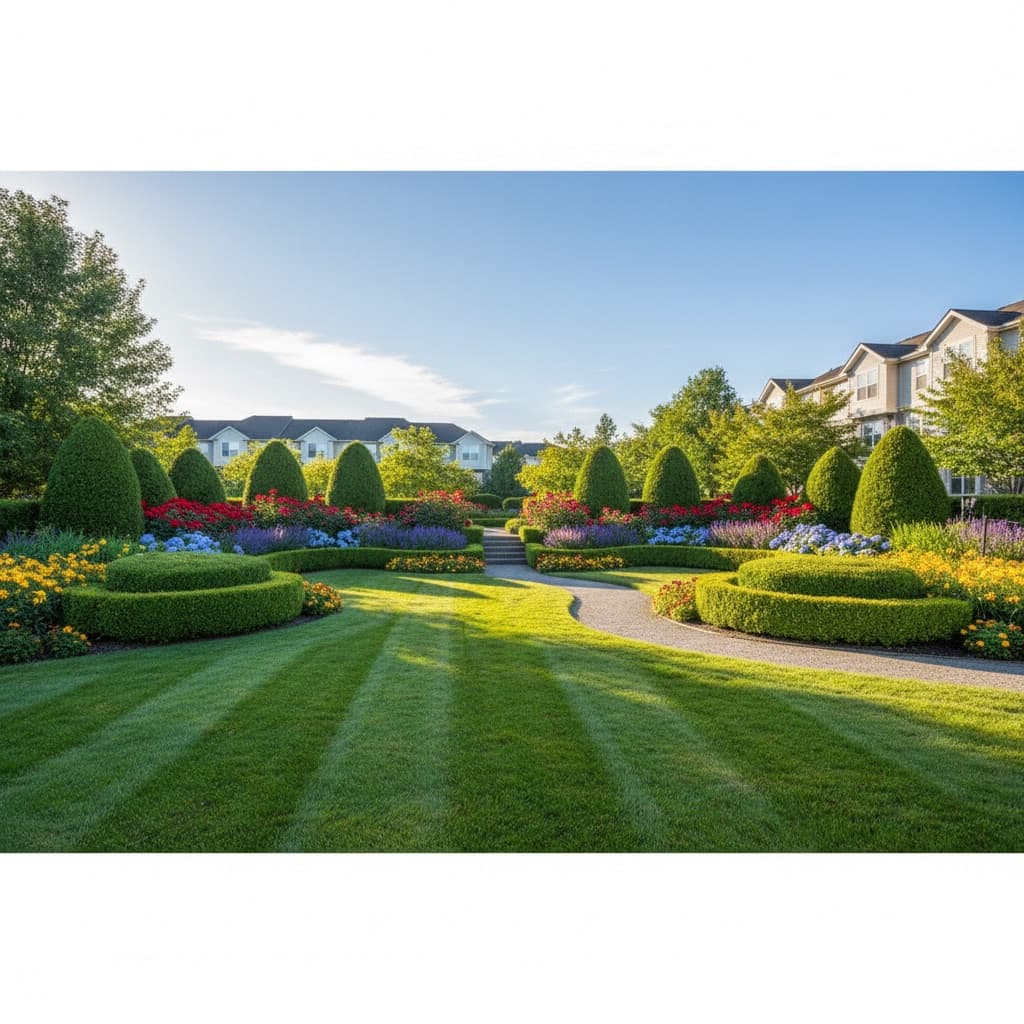
Landscaping is almost certainly your HOA's largest operating expense. For most communities, it eats 30% to 50% of the annual budget — more than insurance, management fees, and utilities combined. A 200-home community with $500,000 in annual assessments might spend $150,000 to $250,000 on landscape maintenance alone.
Despite that, many boards treat landscaping on autopilot. They renew the same contract year after year, don't track performance metrics, and only pay attention when a homeowner complains about dead grass near their lot. That's expensive passivity. Active landscape management — proper budgeting, tight contracts, seasonal planning, and vendor accountability — can save your association 15-25% on landscaping costs while improving curb appeal.
How Much Should Your HOA Spend on Landscaping?
The answer depends on your community's size, climate, and amenity level. But industry benchmarks provide a useful starting point.
| Community Type | Landscaping as % of Operating Budget | Typical Per-Home Annual Cost |
|---|
| Minimal common areas (entry monument, perimeter) | 15-25% | $200 - $500 |
| Moderate common areas (parks, trails, medians) | 30-40% | $500 - $1,200 |
| Extensive common areas (golf course, lakes, athletic fields) | 40-55% | $1,200 - $3,000+ |
If your spending falls significantly outside these ranges, investigate. Spending below the range often means deferred maintenance that'll cost more later. Spending above usually means the contract is overpriced or the scope includes services you don't actually need.
Breaking Down the Landscaping Budget
Your annual budget should itemize landscaping costs by category, not lump them into a single line item. Here's a typical breakdown:
| Category | % of Landscaping Budget | Notes |
|---|
| Mowing and edging | 25-35% | Weekly during growing season, biweekly off-season |
| Irrigation and water | 15-25% | Highly variable by region; arid climates are higher |
| Tree and shrub care | 10-15% | Pruning, disease treatment, removal/replacement |
| Seasonal plantings and annuals | 5-10% | Entry monuments, common area beds |
| Fertilization and weed control | 8-12% | 4-6 applications per year typical |
| Mulch and ground cover | 5-8% | Annual or biannual refresh |
| Hardscape maintenance | 3-5% | Walkways, retaining walls, drainage |
| Contingency / unplanned | 5-10% | Storm damage, emergency tree removal, irrigation breaks |
Tracking costs by category lets you spot trends. If irrigation costs jump 40% year over year, you know to investigate — it could be a leak, a broken controller, or a rate increase from the water utility. A single "landscaping" line item hides these signals.
The Landscape Vendor Selection Process
Finding the right landscaping vendor is one of the most impactful decisions a board makes. A bad landscaper doesn't just cost money — they create homeowner complaints, damage property values, and consume board time. Here's how to run a proper bid process.
Step 1: Define the Scope of Work
Before you contact a single vendor, write a detailed scope of work. This document becomes the basis for every bid and the backbone of your contract. It should include:
- Property map highlighting all areas to be maintained, with square footage estimates
- Mowing specifications: cutting height (typically 3-3.5 inches for cool-season turf, 1.5-2.5 for warm-season), frequency by season, clipping disposal method
- Edging requirements: which hardscape edges, frequency, acceptable edging methods
- Irrigation management: seasonal adjustment schedule, leak monitoring, controller programming, winterization and spring startup
- Tree and shrub care: pruning schedule, dead/dying plant replacement policy, pest and disease monitoring
- Fertilization and weed control: number of applications per year, product types (organic vs. synthetic), pre-emergent schedule
- Seasonal color program: locations, number of annual rotations (typically 2-3), plant types
- Mulch application: frequency, depth (2-3 inches standard), material type
- Leaf and debris removal: frequency, disposal method
- Snow and ice management (if applicable): trigger depth, treated areas, material types, response time
The more specific your scope, the more comparable the bids will be. Vague scopes produce vague bids, and you end up comparing apples to oranges.
Step 2: Solicit Bids
Get at least 3 bids, ideally 4-5. For each vendor:
- Provide the same scope of work document to every bidder
- Schedule a joint site walk so all bidders see the same conditions and can ask questions
- Set a firm bid deadline — give vendors 2-3 weeks to respond
- Require itemized pricing by service category (not just a lump sum)
- Request 3 references from similar-sized communities
- Require proof of insurance: general liability ($1M minimum), workers' comp, and auto liability
Step 3: Evaluate and Select
Don't pick the cheapest bid. The lowest-price vendor is often the one who'll cut corners, send untrained crews, or hit you with change orders. Evaluate on these criteria:
| Criteria | Weight | What to Look For |
|---|
| Price | 30% | Competitive but not suspiciously low |
| Experience | 20% | 5+ years in HOA/commercial, similar community size |
| References | 20% | Call all 3 — ask about responsiveness and complaint resolution |
| Crew quality | 15% | Dedicated crew assigned to your property (not rotating) |
| Equipment | 10% | Commercial-grade, properly maintained |
| Communication | 5% | Designated account manager, responsiveness during bid process |
A vendor who's 10% more expensive but has stellar references and a dedicated account manager will save you money in the long run. The cheap vendor who doesn't return calls costs you in homeowner complaints, board meeting time, and eventual re-bidding.
Structuring the Landscape Contract
Your landscape contract should be detailed enough that any board member can evaluate whether the vendor is performing. Here are the essential clauses:
Term and Pricing
Multi-year contracts (2-3 years) are generally better than annual agreements. They give the vendor incentive to invest in your property and provide your board with cost predictability. Include:
- Base term: 2-3 years with annual renewal option
- Price escalation cap: 3-5% annual increase maximum, tied to CPI or a fixed rate
- Termination clause: 30-60 day written notice for termination without cause; immediate for cause (with defined triggers)
- Monthly flat rate for base services, with unit pricing for add-ons (extra mulch runs, emergency tree removal, etc.)
Performance Standards
Tie the contract to measurable performance standards, not subjective quality assessments. "Landscaping shall be maintained in good condition" is unenforceable. Instead:
- Turf shall be mowed weekly March through October, biweekly November through February, maintaining a height of 3 to 3.5 inches
- Irrigation systems shall be inspected monthly during the watering season with a written report submitted to the board
- Dead or dying plants shall be replaced within 14 days of notification or discovery
- All common area beds shall be free of weeds exceeding 2 inches in height
- Debris from maintenance activities shall be removed the same day
Insurance and Indemnification
Require the vendor to carry general liability ($1M minimum), workers' compensation, and commercial auto insurance. The HOA should be named as an additional insured. The vendor should indemnify the association for any damage caused by their crews.
Communication Requirements
The contract should specify a single point of contact (account manager), response time for non-emergency requests (48 hours), response time for emergencies (4 hours), and a monthly or quarterly property walk with a board representative.
Seasonal Maintenance Schedules
Landscaping needs change throughout the year. A seasonal schedule ensures nothing falls through the cracks and helps the board verify the vendor is performing all contracted services.
Spring (March - May)
- Irrigation system startup and inspection — check for winter damage, test all zones, program seasonal schedules
- Pre-emergent herbicide application (before soil temperatures reach 55F consistently)
- Spring fertilization (balanced NPK for turf, slow-release for beds)
- Mulch refresh in all common area beds (2-3 inch depth)
- First seasonal color installation at entry monuments and high-visibility areas
- Tree and shrub pruning — remove dead wood, shape hedges, crown-raise trees over walkways to 8 feet
- Annual turf aeration (cool-season grasses: early spring or fall; warm-season: late spring)
Summer (June - August)
- Weekly mowing at peak growth — adjust height up 0.5 inches during drought stress
- Irrigation monitoring — adjust run times based on rainfall and temperatures; check for leaks weekly
- Pest monitoring and treatment — grubs, chinch bugs, fungal diseases are most active in summer
- Mid-season fertilization (light nitrogen application for cool-season turf if not in dormancy)
- Second seasonal color rotation (swap spring annuals for heat-tolerant summer varieties)
- Hardscape inspection — check walkways, retaining walls, drainage for summer storm damage
Fall (September - November)
- Fall fertilization — the most important fertilizer application for cool-season turf (high potassium for root development)
- Overseeding bare or thin areas in cool-season lawns
- Leaf removal — weekly during peak leaf drop, twice weekly if heavy canopy
- Third seasonal color installation (mums, ornamental kale, pansies depending on region)
- Tree and shrub fall pruning — shape before dormancy, remove hazardous limbs before winter storms
- Irrigation system winterization — blow out lines before first freeze
Winter (December - February)
- Dormant pruning for deciduous trees and shrubs — best visibility of branch structure
- Hardscape repairs — address trip hazards, pressure wash walkways and pool decks
- Snow and ice management (cold-climate communities) — plowing, salting, shoveling
- Equipment maintenance — vendor should be servicing mowers, blowers, and irrigation equipment
- Annual landscape plan review — assess what worked, what didn't, plan next year's improvements
- Budget planning for next fiscal year — get vendor pricing for any scope changes
Water Conservation and Drought Management
Water is one of the fastest-rising costs for HOA landscaping programs, particularly in the Western states. Many communities have reduced irrigation costs by 30-60% through smart water management. Here's how.
Smart Irrigation Controllers
Weather-based irrigation controllers (also called ET controllers or smart controllers) adjust watering schedules automatically based on temperature, rainfall, humidity, and wind. They cost $200-$800 per controller and typically pay for themselves within one irrigation season through water savings.
Water-Efficient Plant Materials
Replacing high-water turf areas with drought-tolerant alternatives can cut water use dramatically. Options include:
- Native grasses and groundcovers — adapted to local rainfall, minimal supplemental water needed
- Xeriscaping — rock, mulch, and drought-tolerant plantings (reduces irrigation by 50-75%)
- Synthetic turf — for high-visibility, low-use areas like medians and entry monuments ($8-$14/sq ft installed, but zero water cost going forward)
- Drip irrigation — for shrub and flower beds, reduces water use by 30-50% compared to spray heads
Many water utilities offer rebates for water-efficient landscape conversions. Check with your local utility before starting any conversion project — rebates can offset 30-50% of the upfront cost.
Drought Response Stages
Your HOA should have a drought response plan with defined stages that match your local water authority's restrictions:
- Stage 1 (voluntary): Reduce irrigation to 3 days/week, raise mowing height 0.5 inches, suspend new plantings
- Stage 2 (mandatory): Reduce to 2 days/week, suspend seasonal color rotations, allow dormancy in non-critical turf areas
- Stage 3 (severe): Reduce to 1 day/week, irrigate only entry monuments and high-visibility areas, communicate with homeowners about temporary appearance changes
Handling Homeowner Landscaping Complaints
Landscaping generates more homeowner complaints than almost any other HOA function. Most complaints fall into predictable categories:
- "The common area near my lot looks terrible" — usually a legitimate concern; inspect, document, and address with the vendor
- "They're mowing too early / blowing leaves at 7am" — set work hours in the contract (typically 8am-6pm on weekdays)
- "The landscapers damaged my property" — document the damage, report to the vendor, file against the vendor's insurance
- "Why are we spending so much on flowers nobody asked for?" — a budget transparency issue; publish landscaping costs in your financial reports
- "My neighbor's yard is a mess and the HOA isn't doing anything" — this is a CC&R enforcement issue, not a common area landscaping issue; handle through your violation process
The Complaint Tracking System
Don't let complaints disappear into email threads. Track every landscaping complaint in writing with the date, location, description, action taken, and resolution. This system serves three purposes:
- Vendor accountability. Bring the complaint log to monthly or quarterly vendor meetings. Patterns of complaints in the same area indicate underperformance.
- Budget justification. If you need to increase the landscaping budget, documented complaints about deferred maintenance provide evidence.
- Board defense. If a homeowner escalates a complaint to a lawsuit, your documented response history shows the board acted responsibly.
Using HOA management software to track maintenance requests and complaints creates a searchable, timestamped record that persists across board transitions. It's a significant improvement over the informal "the board president will talk to the landscaper" approach.
Common Landscaping Mistakes HOA Boards Make
- Renewing the contract without rebidding. Rebid every 3 years at minimum. Even if you stay with the same vendor, the process keeps them honest on pricing.
- Accepting a lump-sum bid without itemization. You can't manage what you can't measure. Require line-item pricing for every service category.
- Ignoring irrigation infrastructure. A leaking irrigation system wastes thousands of dollars per year in water costs. Inspect the system at least twice a year — spring startup and mid-summer.
- Deferring tree maintenance. Removing a dead tree after it falls on a car costs 3-5x more than proactive removal. Plus the liability claim.
- Not having a contingency line. Storm damage, irrigation breaks, and emergency tree removal are predictable in aggregate even if the timing is unknown. Budget 5-10% for unplanned landscape expenses.
- Making landscape decisions by committee email. Designate one board member — usually the grounds committee chair — as the primary contact for the vendor. Multiple points of contact create confusion and contradictory instructions.
Landscape Improvement Projects
Beyond routine maintenance, your board may undertake landscape improvement projects: entry monument upgrades, trail installations, common area renovations, or large-scale drought conversions. These projects should be funded from reserves or through a special assessment, not the operating budget.
For any project over $10,000:
- Get a landscape architect's design plan (cost: $2,000-$10,000 depending on scope)
- Solicit 3-5 bids from licensed contractors — not just your maintenance vendor
- Verify contractor licensing, bonding, and insurance
- Present the project and cost to homeowners at a board meeting before proceeding
- Build in a 10-15% contingency for unexpected site conditions
- Inspect the work at completion against the design plan before making final payment
The Bottom Line
Landscaping is too expensive and too visible to manage passively. A detailed scope of work, a competitive bid process, measurable performance standards, and active vendor management can save your HOA 15-25% on landscape costs while keeping your community looking sharp.
Start with your budget. Break out landscaping costs by category. Compare them to the benchmarks above. Then review your contract — if it doesn't have measurable performance standards and a clear scope, it's time to rewrite it.
Need a better way to track landscaping expenses, vendor performance, and homeowner complaints? See how Effortless HOA can help your board manage vendors and budgets in one place.